Wooden Multiplication Board for Kids: 5–10 Min Routines
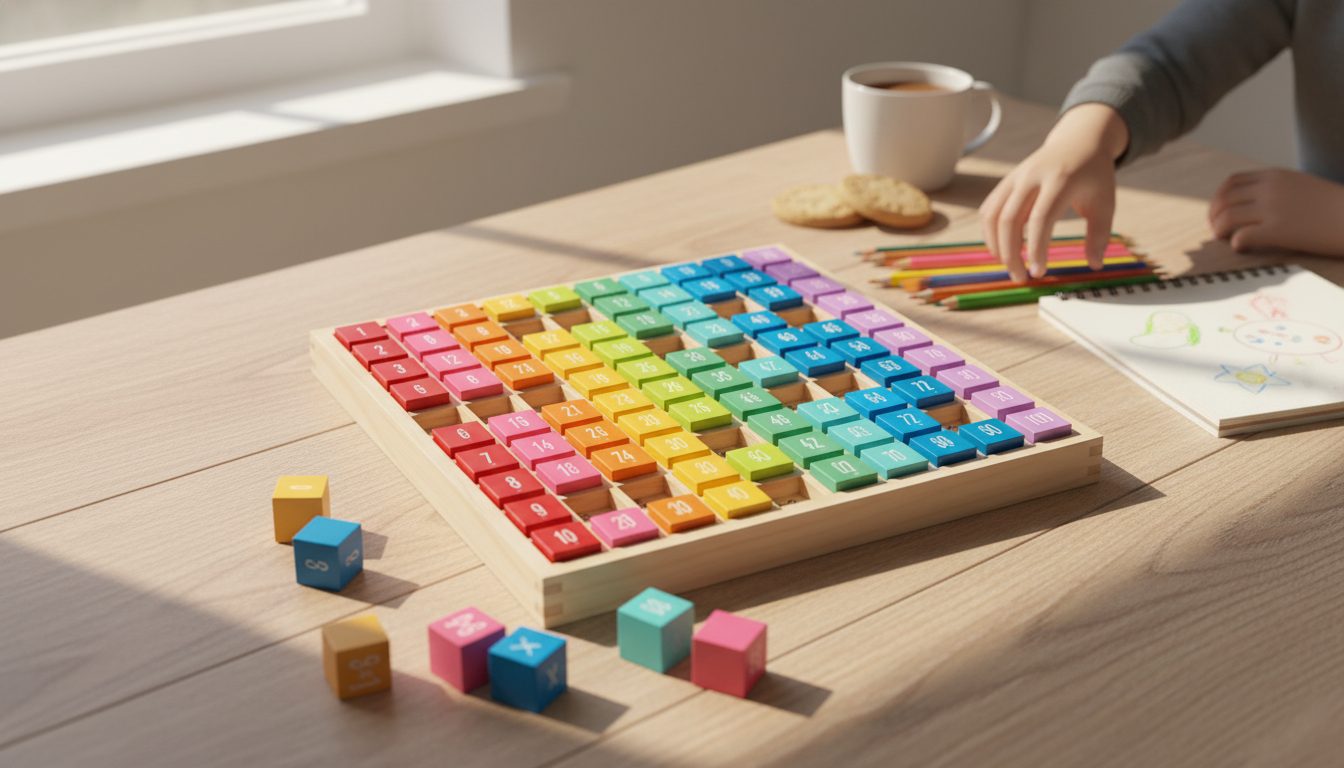
A wooden multiplication board turns times tables into a tactile, repeatable routine. Instead of relying only on worksheets or apps, kids can see number patterns, practice facts in small doses, and build confidence through quick self-checking. This guide explains how the board works, what skills it supports, and simple ways to use it for short daily practice sessions.
What a multiplication board is and how it works
A multiplication board is a structured layout that maps factors (often 1–10 or 1–12) to products, helping kids connect repeated addition to multiplication. Most boards organize factors along the top and side so children can locate a fact like 3×4 by following the row and column to its product.
The hands-on interaction—placing pieces, pointing, or tracing—adds movement to math practice. For many learners, that physical “do and see” step improves attention and makes practice feel less abstract than a page of problems.
Because products are arranged in a consistent grid, visual patterns become easier to notice and remember: perfect squares along a diagonal (like 4×4), doubles and near-doubles, and commutative pairs (3×4 and 4×3). Over time, the board becomes a practical bridge from counting strategies to fluency—kids can confirm answers quickly at first, then gradually rely less on the board as facts stick.
Skills it can build beyond memorization
Number sense and pattern spotting
Multiplication boards naturally highlight patterns such as even/odd results, diagonal squares, and skip-counting sequences. When kids discover that the 5s often end in 0 or 5, or that 9s have recognizable patterns, facts start to feel logical instead of random.
Fluency and retrieval with less stress
Short, frequent practice builds speed and reduces cognitive load during multi-step problems like long division, fractions, and word problems. A board also supports quick self-checking, which keeps momentum going and lowers frustration when a fact doesn’t come instantly.
Error awareness and math language
Instead of being “wrong and stuck,” kids can compare a guess to the board’s structure and correct it independently. This is a great moment to introduce math language in context—factors, product, equal groups, arrays, and turn-around facts—without turning practice into a lecture.
Confidence through small wins
Starting with friendlier families (2s, 5s, 10s) creates quick victories. Those small wins make it easier to keep going when it’s time to tackle tougher sets like 7s, 8s, and 9s.
Quick-start routines (5–10 minutes)
Consistency matters more than duration. A brief routine done most days helps facts move from “figuring out” to “just knowing.”
- Warm-up focus set: practice one family per day (2s today, 3s tomorrow) instead of the entire table at once.
- Cover-and-check: cover products with a card, say the fact aloud, then reveal to confirm.
- Turn-around hunt: find matching commutative pairs (6×4 and 4×6) and talk about why they match.
- Targeted review: keep a short list of “tricky facts” and revisit them daily until they become automatic.
- Timed-but-friendly rounds: aim for accuracy first; increase pace only after consistent correctness.
For a broader view of effective math learning goals and classroom-to-home consistency, the National Council of Teachers of Mathematics (NCTM) and Stanford’s Youcubed both emphasize understanding, patterns, and confidence-building alongside practice.
Games that keep practice from feeling like drills
Kids who need extra support often benefit from quick feedback and lots of correct repetitions; research summaries from the What Works Clearinghouse (Institute of Education Sciences) can help families understand which intervention elements tend to be effective.
Choosing the right difficulty for age and stage
Simple weekly practice plan
| Day | Focus facts | 5-minute activity | 1-minute wrap-up |
|---|---|---|---|
| Mon | 2s | Cover-and-check the 2s row | Say 3 random 2s facts aloud |
| Tue | 5s | Find patterns (ends in 0 or 5) | Quick quiz: 5×3, 5×7, 5×9 |
| Wed | 10s | Skip-count by 10 and point to products | Spot-check 4 facts |
| Thu | 3s | Turn-around hunt (3×4 and 4×3) | Repeat 2 tricky 3s facts |
| Fri | Mixed review | Mystery product (12, 18, 24) factor pairs | Celebrate a new mastered fact |
Care, safety, and setup tips for wooden learning toys
Product spotlight: Wooden Multiplication Board for Kids
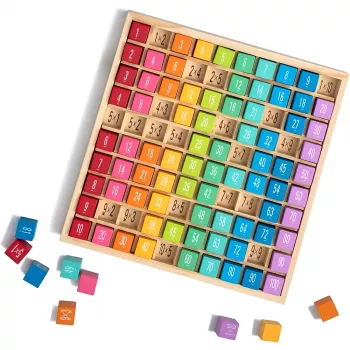
If you want a simple, durable tool that supports repeated practice and pattern-finding, the Wooden Multiplication Board for Kids is designed for hands-on learning in short daily sessions. It works well for homework support and independent review once a routine is established, and it’s compact enough to keep in a dedicated math corner.
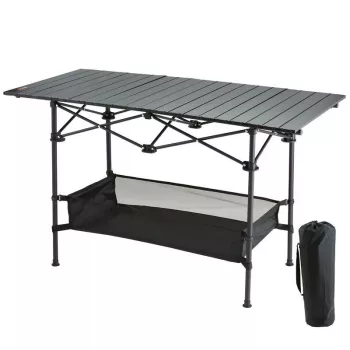
To make that math corner easy to set up anywhere—kitchen, living room, or even outdoors—a sturdy surface helps. A lightweight option like the Portable Folding Camping Table can double as a quick pop-up practice station when you don’t want materials spread across the dining table.
FAQ
What age is a wooden multiplication board best for?
Most kids use a multiplication board during elementary school, especially when they’re first building fact fluency. Starting with easier fact families and moving up based on readiness tends to work better than following age alone.
How long should kids practice multiplication facts each day?
About 5–10 minutes a day is usually enough when it’s consistent. Prioritize accuracy first, then mix quick review with one small set of new facts to keep progress steady.
Can a multiplication board help kids who struggle with memorization?
Yes—visual and tactile support can reduce the mental load, help kids notice patterns, and provide fast self-checking. As confidence grows, the goal is to use the board less often and rely more on mental recall, with occasional checks for accuracy.












Leave a comment